1497/98 - 1543 • German • Painter • Northern Renaissance
"Your friend is a wonderful artist."- Sir Thomas More, c. 15 26, writing to Erasmus of Rotterdam
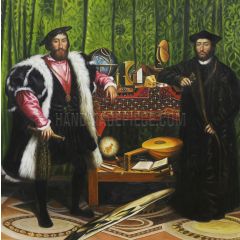
Hans the Younger trained with his father in Augsburg, Germany, then left to settle in Basel, Switzerland, around 1514. Basel was also home to Erasmus of Rotterdam, the great Catholic HUMANIST, who became Holbein's friend. In 1521/22, probably as the predella for a large ALTARPIECE, Holbein painted a macabre Christ in the Tomb (Dead Christ): a life-size cadaver laid out horizontally, at eye level. Holbein spared none of death's horror, including a lurid coloring of the corpse and the look of rigor morris. He brings MANTEGNA'S notorious Dead Christ (c. 1500) to mind-it is as though Holbein decided to move the viewer from the end of the stone slab where Mantegna stood to an uncomfortably close position, almost inside the sarcophagus. Contemplating such images of Christ, indeed, to "dwell in the wounds of Christ," as Thomas a Kempis recommended, was a popular form of mysticism, the devotio moderna (modern devotion), of the 15th and early 16th century. As Protestant influence spread and Church commissions declined, Holbein concentrated on portraits and then, in 1526, left for England with a letter of introduction from Erasmus to Sir Thomas More. More's response is quoted from above. Holbein's portraits of both men are among his best known. More became lord chancellor in 1529 but resigned the post in 1532 because he could not condone King Henry VIII's wish to divorce. In 1535, More was beheaded for his intransigence. In the meantime, Holbein had been receiving commissions from members of the court and by 1537 he became court painter. He made several portraits of Henry, and was sent on missions to paint likenesses of the king's prospective brides. Holbein's meticulous, microscopic details and his evocation of rich, deep light and texture are compared with van EYCK's. Also like van Eyck, Holbein used elaborate symbolism, especially in The French Ambassadors of 153 3, a full-length portrait of two friends, one a cleric, the other a wealthy nobleman. Every element in this large work (almost 7 feet square) is charged with meaning: A nearly hidden crucifix suspended in the upper left corner reminds one of the uncertain status of the Catholic Church during the period; celestial and terrestrial globes bring to mind that Holbein was painting in the great Age of Exploration. More ambiguous, and certainly suggestive, are a lute with broken string, a book of hymns open to a page of songs by Martin Luther, and, most famously, an exceedingly strange object on the floor. It is an anamorphosis (from a Greek word meaning "transform"), a trick of PERSPECTIVEW: hen seen at an acute angle, its true form-that of a skull is revealed. A skull was the personal emblem of one of the noblemen in the picture. It also relates to the ICONOGRAPHY of the Crucifixion, pictures of which, beginning in the 9th century, often showed "Adam's skull" on the ground below the Cross. In addition, the name Holbein actually means "hollow bone," which can be interpreted as "skull." Skulls have several other symbolic meanings, but with his anamorphic rendering Holbein may have been enjoying a game of one up man ship at the expense of his contemporary DURER. Durer invented a perspective drawing system for which he used a lute as an illustration. Holbein's lute is foreshortened, as was Durer's, but Holbein's skull is seen from a more radical and far more complex perspective. This perspective and metaphorical play of skull and (broken) lute offers absorbing interpretive challenges to art historians.


 Choose Size & Frame Starting from$196.00