c. 1581/85 - 1666 • Dutch • Painter • Baroque
"[Hals was] ... somewhat merry in his life." - Matthias Scheits, 17th century
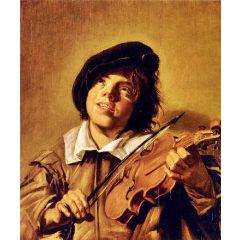
The assessment by Hals's contemporary quoted above is part of the bon-vivant reputation that has attached to the artist, partly from the pictures he painted and somewhat from hearsay-Scheits studied under a man who had been Hals's student. The sitters for Hals's many portraits gaze out to meet our eyes with a twinkle in theirs; a smile plays at the edges of their mouths. The spontaneity in Hals's pictures is also reflected in his method of painting: He was one of the earliest European painters to work directly on the canvas without underpainting-ALLA PRIMA. Hals's first masterpiece-called the first monumental masterpiece of 17thcentury Dutch painting-was a group portrait of a dozen men, Banquet of the Officers of the Haarlem Militia Company of Saint George (1616). The men are all seated or standing around a table, and react as if interrupted in the midst of their banquet-it is the same "candid camera" effect pioneered by MASSYS 100 years earlier and taken up again by REMBRANDT in Syndics of the Clothmakers' Guild (1662). The individuality of each man seems bolstered by a current of optimism, which may be attributed to the new Dutch Republic that these militiamen had helped secure. Hals himself was a member of the company. When juxtaposed with a rendering of the same militia company, also gathered around a table, painted several years before by Cornelis van Haarlem (1562-1638), the works serve well to illustrate WOLFFLIN's point-by-point contrasts between the art of the RENAISSANCE (ITALIAN and NORTHERN) and that of the 17th-century BAROQUE. Hals also introduced a new measure of vitality to pictures of the working classes, whom he represented with frankness, affection, and sometimes wicked humor, as in Malle Babbe (c. 1633-35): A disreputable- looking woman holding a huge tankard of beer, an owl on her shoulder, seems to be laughing and shouting at once. Observers tend to infer sincerity from a spontaneity of manner such as that of Hals, but little is known about his character, personality, or working methods-not a single DRAWING, ETCHING, or ENGRAVING by his hand is securely known. Records do show that he was sued by his butcher, baker, and shoemaker, suggesting that he was a poor financial manager. His first wife died, and his second, who gave birth nine days after the marriage, got in trouble more than once for brawling. Five of his sons were among his pupils, as were LEYSTER, van OSTADE, and BROUWER. The originality of his approach is most apparent when a canvas is looked at from close range, where it seems a mass of disparate, loose, irregular strokes and daubs of paints. But stepping back from the canvas brings it coherence. Hals's popularity and importance as a portraitist declined in the 1640s as Dutch taste turned to a more refined and aristocratic style. Yet his most sensitive and penetrating representations of a wide range of personalities also date to his last decades. In r 664, when he was about 80 years old, he painted Regentesses of the Old Men's Home. In portraying these five elderly women Hals showed the range of both his psychological and his painterly skill. Nevertheless, his influence declined and it was not until Hals was admired by the Impressionists (the American CHASE included a reproduction of Malle Babbe in one of his own works) that his paintings were rediscovered, and then sold for huge sums of money.