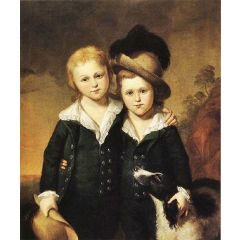
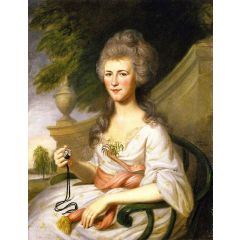
1741 - 1827 • American • Painter • Colonial
"Can the imagination conceive anything more interesting than such a museum?-Or can there be a more agreeable spectacle to an admirer of the divine wisdom!" - Charles Willson Peale
Roughly contemporary with COPLEY but a native of Maryland rather than Boston, Peale was a saddlemaker before he took up art-he received painting lessons from John Hesselius ( 1728-1778) in exchange for a saddle. He also went to Boston to see Copley, and made the ambitious artist's obligatory trip to London to study in WEST's studio before Copley did. Unlike Copley, though, Peale was eager to return home. He was also happy to leave the HISTORY PAINTING that West practiced and paint the portraits he knew would buy his meals-portraiture dominated American art well into the 19th century. The faces that look out from Peale's canvases have their mouths curved up in a particular smile that becomes recognizable as Peale's signature. Most of his subjects appear charming, and none more so than in The Peale Family (1773 and 1808 ). Gathered around a table, as were those in SMIBERT's important Bermuda Group (Dean George Berkeley and His Family) of 50-plus years earlier, the family members here are relatively informal and unpretentious; moreover, even the dog, whose head is in the front of the picture, has a sweet face. Peale painted many important Americans, and in General George Washington before Princeton (1779) gave Washington the benevolent Peale smile. Four years before his death, the board of trustees of the Pennsylvania Academy commissioned a self-portrait from Peale, who had moved to Philadelphia just prior to the Revolutionary War. The Artist in His Museum (1822) shows Peale lifting a drape and providing a view into the natural history and science displays of the museum he founded and opened to the public in 1794. (It is his idea for this museum that he describes in the quotation above.) Shadow boxes hold specimens of North American birds along the wall, and in the foreground of the picture is an American turkey and the skeleton of a mastodon. Peale himself took part in digging up the prehistoric bones, and painted a picture of the excavation in progress: The Exhumation of the Mastodon ( 1806). The museum's intention was didactic, in line with Peale's commitment to education. He was convinced that painting was a skill to be learned, not a talent one is born with and he inspired several members of his family to paint. He actively supported women's equality, and his liberality bore fruit: At least nine women artists can be linked to Charles Peale through either lineage or marriage. He gave his brother, James (1749-1831), his first lesson; three of James's daughters were painters, and two of them, Anna (1791-1878) and Sarah Miriam (1800-1885), were elected to membership in the Pennsylvania Academy of the Fine Arts. Charles's sons, Raphaelle (1774-1825), Rembrandt (1778-1860), and Rubens (1784- 1865), were highly accomplished painters.


 Choose Size & Frame Starting from$273.00