
Product added to cart
Mark Rothko's Iconic Paintings and Their Significance
Mark Rothko (1903-1970) was one of the Abstract Expressionists, a movement that emerged in the United States as a reaction to World War II. People were dismayed after witnessing the horrors of war. When these anxieties mixed with European modernism, a cultural moment was created where artists employed total abstraction in their art. Officially referred to as the Abstract Expressionists in 1946, these artists, such as Rothko, pushed the radical transition from the figure to the abstract, marking the shift of the art center from Paris to New York City and paving the way for future generations of radical artists.
The early Abstract Expressionists were placed into two camps: gestural and color field painters. Color field painters, such as Rothko, were known to paint huge canvases in few colors. These large regions of color coined their name "color field". In Rothko's mind, this type of painting was meant to overwhelm the viewers, since these large monochrome canvases were the only object in their field of vision on a gallery's wall. He experimented with different layers of paint, softness of form or hardness of lines, luminosity, and juxtaposition of various shades to evoke different emotional responses in the viewers. Color field painting was his way of expressing universal human emotions, like grief or ecstasy, that personally connected with each viewers. In doing so, Rothko believed he could create a quasi-religious experience in the viewers, who would feel enveloped by powerful emotions when looking at his work.
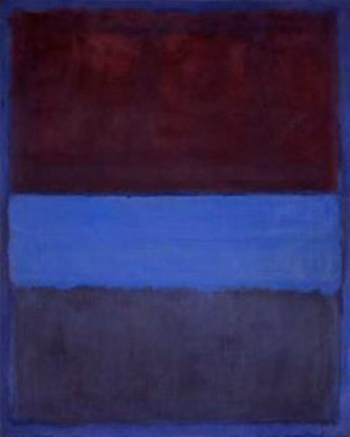
One of Rothko's iconic works includes No.61, Rust and Blue (1953). This 115.25” x 92” oil on canvas is divided into three parts: a rusty red, light cobalt blue, and a dark, almost black, shade of blue. Rothko used a thin wash technique, where he mixed oil and egg-based media, to achieve what he called an "inner light" effect. This effect created the hazy lines and, in his mind, allowed him to show depth on an otherwise flat surface. This exemplifies Rothko's color field style and emotional depth as he explored ways to mimic the techniques of the Old Masters.
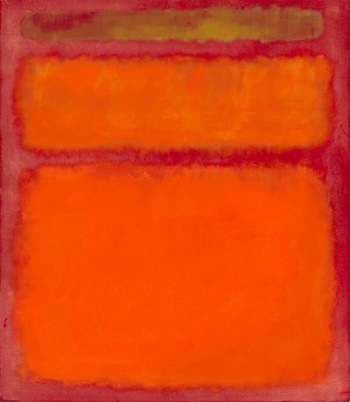
Another work is Orange, Red, Yellow (1961), a 93" x 81.25" acrylic on canvas. This work employs a warmer color palette, rich with orange, red, and yellow hues. The background is painted red, with three sections of yellow and orange. Each field varies in size. Bought in the same year it was created by David Pincus, a famous American art collector at the time, this piece then sold for $86,882,500, setting a new record at Christie's Post War and Contemporary Art auction in May 2012. This work embodies Rothko's exploration of emotional intensity because of its scale and bright, warm colors.
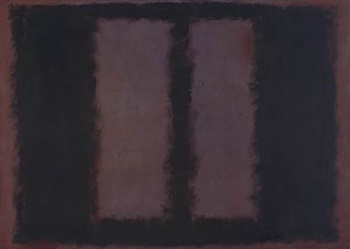
Black on Maroon (1958) takes a different approach to Rothko's color fields. This 105" by 150" mixed media work is comprised of a maroon background with a black rectangle and two smaller, vertical maroon rectangles. The maroon pigment of these smaller sections has blended with the black and red background colors, creating a more mauve-like color in the center. In doing so, this makes the composition overall appear as a minimalist version of a window. In this work, Rothko explores the feeling of entrapment which is heightened by the combined dark color palette and window motif.
During the 1960s, Rothko was commissioned to paint 14 murals for John and Dominique de Menil, who planned on building a chapel for the St. Thomas Catholic University in Houston. This series differs from his previous work, with three triptychs and five paintings all in monochrome black with various undertones. The chapel opened in 1971 as a place for people of all faiths, offering a sanctuary for meditation and peace. As Rothko's work was concerned with introspection, the chapel offered the opportunity for him to heighten his intention of creating a spiritual experience for the viewers.
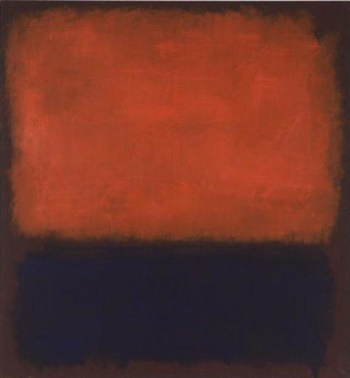
At this point in his work, Rothko turns to a subdued and dark color palette. No.14 (1960) is a 114.5” x 105.63” oil on canvas. It depicts two deep red and navy rectangles on a field of dark purple. These colors evoke what Rothko believed to be "the Sublime", or the feeling of inspiring awe. He believed the use of color could create an emotional response in the viewers. Although his work was always concerned with spirituality, his shift to a dark color palette most likely correlated to his inner turmoil at the time as well.
It was artists such as Rothko that changed the trajectory of art history. Never before had artists completely turned away from representational subject matter in favor of complete abstraction, effectively challenging how the public had come to define art and notions of beauty. This change into the abstract would also lead many to believe this art form to be apolitical, not involving political subject matter whatsoever. Because of this, other art movements would form in opposition to Abstract Expressionism, such as the Neo-Dadaists, a group that would bring back political subject matter in untraditional ways. Many other groups would form from the 1950s onward, playing around with the ideas that originated from the Abstract Expressionists. Minimalism furthered the abstraction of subject matter in an attempt to overtly challenge the traditional aesthetics of the art world while Pop Art returned to representational subject matter to redefine what could be considered art.
Even though he did not see himself as an Abstract Expressionist, Rothko was a leading figure of the movement. Known for his color field paintings, Rothko evoked emotion through simple forms and color, paving the way for other modern art movements.
Exploring Rothko's work in person is a must to truly understand the emotional significance of his work.
Categories: Famous Artists and Paintings
There are no comments yet