
Product added to cart
A Walk Through Picasso’s Blue Period: Art as a Reflection of Struggle
The Birth of Melancholy: An Artist's Struggle
Imagine stepping into a world where every shade of blue tells a story of sorrow and resilience. Welcome to Picasso's Blue Period. Pablo Picasso (1881-1973) is known as one of the leading artists of Cubism, the early twentieth-century art movement that featured highly abstract geometric forms as painting's subject matter. However, before Picasso became famous for his Cubist works, he went through periods that held more monochromatic interests, such as his Blue Period from 1901-1904. During this time, Picasso struggled to make a living as an artist and was distraught after witnessing the high poverty levels throughout his travels through his home country, Spain, and his new home, France. Likewise, a close friend and fellow artist, Carles Casagemas (1880-1901), committed suicide due to unrequited love around the same time. This caused a deep sense of melancholy and depression in Picasso, causing him to turn to somber themes and subject matter such as human suffering, poverty, and isolation in his art. In this way, he began a period of work with only a blue, green, and gray color palette, naming his so-called Blue Period. The significance of this period marked a turning point in Picasso's career and proved him to be an artist who could provide commentary on society and the human condition. This also laid the groundwork for his later styles, such as his Rose Period and influence on Cubism, which would solidify his place in the art historical canon and make him one of the most well-known artists decades later.
Universal Themes of Sorrow and Resilience
Each work from his Blue Period conveys a deep sense of the universal human experience of mourning, loss, and struggle with mortality. He also shed light on those deemed unworthy, like the elderly, disabled, and the poor. Yet, he did so in ways that highlighted society's beauty and resilience in the face of adversity. Because of this, Picasso's Blue Period shows us that death and misfortune are facets of society, but they are not always a constant and society is more resilient than it seems.
Visual Narratives of Despair: A Closer Look
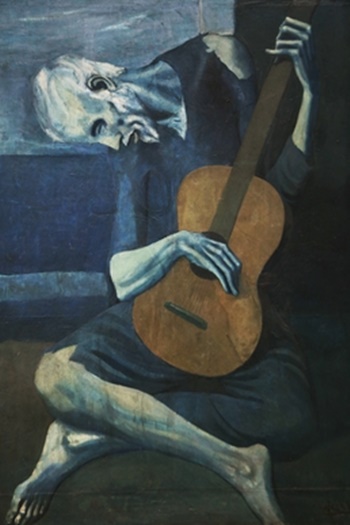
Examining three of Picasso's works from his Blue Period will show how he expressed these universal themes of despair and struggle. One of his works, considered his most well-known during this period, is The Old Guitarist (late 1903–early 1904). This painting depicts an old man seated on the ground and holding a guitar. His ripped clothing and skeletal form imply that this unknown man is poor and perhaps is performing for money. As Picasso was concerned with the outcasts of society at this time, the old man depicted is not only poor but also blind. The blue palette solely used for the man's figure and surroundings further indicates his closeness to death and that the warm, brown guitar is his only hope for survival. All of this shows the struggles that the lowest economic class and those who were disabled faced, as well as despair at their plight.
Life's Cycles in La Vie
Another painting is La Vie (1903), which depicts two nude figures, one male and one female, on the left and a clothed, motherly figure holding a swaddled baby on the right. The background depicts two drawings. One shows two nude figures huddled together on the ground, while the lower one shows a single nude figure hunched in a fetal-like position. Creating an image within an image is called mise en abyme, a common art trope used to express an ever-recurring sequence. With this in mind, and as the title implies, perhaps this painting is meant to be Picasso's rumination on the cycle of life. The mother and baby show the beginning of the cycle with the creation of life while the two drawings depict the middle stage when children grow up and must learn to transition from leaning on the support of their mother to themselves, and finally, the young couple on the left who begin a new life and family together. Scholars agree that the male nude depicted is Picasso's late friend Carles Casagemas. With this in mind, La Vie shows Picasso's struggle with life and death as a natural cycle that does not erase the grief that comes with it.

An Introspective Reflection: Picasso’s Self-Portrait
Finally, Picasso created a self-portrait at the turn of the twentieth century in 1901, the same year Casagemas died. The artist's self-portrait is a common convention throughout art history used to show their likeness and establish themselves visually as an artist. Because of this, many male artists would paint themselves in the act of making art and emphasize their status as gentlemen through their dress. Picasso inverts this tradition by not depicting himself with the tools of an artist and depicts himself in plain clothing. This portrait does not show him in a flattering way at all. Instead, he seems ghostly. His facial features are highly prominent, giving him a sickly appearance, and the blue tones throughout the painting emphasize the isolation of his lone figure. Given that this is a self-portrait, the image has a sense of introspection. Certainly, Picasso needed to work through his grief at his friend's death which caused an internal crisis of his mortality. This could explain why he depicted himself as almost corpse-like.
Isolation in Color: The Loneliness of Outcasts
The use of a predominantly blue palette in The Old Guitarist, La Vie, and his self-portrait creates a somber tone. Undoubtedly, Picasso knew that using these shades of blue, some of which are so light and appear grey, would make the viewer feel his melancholy and inspire their reflection on life and death. It further emphasizes the sadness of his paintings from this period, which already have depressing subject matter. It even strikes the viewer with a sense of coldness, which was possibly Picasso's intent to show the cold reality of the hardships many members of society around him faced at the time.
A Consistent Struggle: The Color of Depression
Likewise, the blue tones emphasize the loneliness and isolation these members experienced. We can also see that visually in The Old Guitarist and his self-portrait, as they appear alone in the painting. While La Vie has multiple figures, they appear removed from one another as there is much space between the mother and baby and the young couple. Similarly, the figures in the background are separated from those in the foreground through their depiction of being hung on the wall as drawings. This may be Picasso's way of highlighting society's outcasts as isolated from the rest of society. In doing so, he could strike compassion and empathy for human suffering into his viewers and hoped to see a change in how society treated the downtrodden.
A Consistent Struggle: The Color of Depression
The use of a blue palette also shows Picasso's struggle with depression, as he did not stray from this style during this period. Thus, the visual consistency of the blue aesthetic means we can read any of his paintings from this time through the lens of melancholy and depression, both Picasso's own and the world around him. This also adds a layer of universality to this period. As there is little indication of specific times or places, each scene shows how suffering is not beholden to Picasso's time.
The Duality of Blue: Hope Amidst Sorrow
While the color blue has these negative associations, it does have positive meanings. In color theory, blue represents serenity, calmness, peace, sadness, and depression. While Picasso latterly used this color palette, we can interpret these paintings as reflecting resilience against life's struggles. So, although the overtones of his Blue Period may be somber, there is an undertone of hope throughout as well. When considering Picasso was a devout Catholic in his early years, we can see this as true, especially as the color blue holds significance in religious iconography. This can also explain why Picasso was so invested in the plight of the poor. In this way, Picasso promoted social justice even if he did not realize it.
A Lasting Legacy: Compassion in Art
The period of Picasso's work from 1901-1904 shows how invested the artist was in human suffering, both his anguish and those around him. His Blue Period, as indicated by the shades of blue, green, and grey, as well as subject matter depicting the outcasts of society, shows his deep turmoil during this time. Many factors led to his Blue Period, such as witnessing the hardships of poverty, his reflections on life and death due to his close friend's death, and his own financial struggles; he turned to somber and melancholic tones in his work. These themes are shown in a few of his works from this period, such as The Old Guitarist, La Vie, and his self-portrait. All of these have the characteristic monochromatic blue color palette, showing the various themes of suffering and mortality that Picasso was working through at the time. The blue tones help show the melancholy, isolation, despair, existential struggle, and introspection he was battling and evoke them in the viewer. The enduring impact of Picasso's Blue Period is the turning point it marked in his career and broader society. The turn of the twentieth century saw many urging for the advances in democratizing society, such as progress in women's rights and reform movements for the lower, working classes. Picasso's work is just one example of many artists who imparted social justice commentary at the time. This is why his work remains relevant today. No matter the time, compassion and empathy for the human condition remain imperative for a just society.
Categories: Famous Artists and Paintings
There are no comments yet